
Tower Rush is a floor-building game of chance from Galaxsys. The tower grows one floor at a time, each successful floor increases the cumulative odds shown on screen, and after every floor comes the choice between collecting the current value and risking another build before the structure collapses. This guide walks through that loop step by step using demo mode, which runs on virtual credits so every control can be learned without financial risk. No amount of timing, tapping or pattern reading can predict a random result, so the aim here is understanding rather than a winning system.
Contents
Tower Rush Facts at a Glance
Before the first build, it helps to know the confirmed facts about the game. Check each of these against the in-game information panel, because RTP configurations and available features can differ between versions and platforms.
| Tower Rush fact | Verified information |
|---|---|
| Developer | Galaxsys |
| Original release | 28 February 2024 |
| Category | Fast Game and Turbo Game |
| Core mechanic | Build floors, increase cumulative odds, collect before collapse |
| Published RTP | 96.2% to 97.6% |
| Bonus-floor types | Frozen, Temple and Triple Build |
| Potential floor count | Limitless |
| Fairness | RNG and provable fairness |
| Official demo | Mobile and desktop |
| Age | 18+ |
If any page or app shows a different developer, an impossible RTP or a promise that these facts do not support, treat it as unreliable and check the official Galaxsys information instead.
Tower Rush Game Screen Explained
The layout is deliberately simple, but naming each part before the first round helps to keep every decision informed. The elements below appear in most versions, though their exact position can change between mobile and desktop.
Main Tower Area
This is the central stage where floors are placed one on top of another. It is the visual record of the round in progress and shows how tall the structure has grown, but height alone does not make the next floor safer.
Build Control
The Build control starts the next floor attempt. Pressing it commits another floor and exposes the whole run to a possible collapse, so it is the button that carries the risk in every round.
Collect or Cash-Out Control
This control ends the round and secures the value currently displayed. Once the round is collected, it is over and the accumulated value is locked in, whatever the tower would have done next.
Stake Selector
The stake selector sets how many virtual credits are placed on the round. It changes the numbers on screen but not the probability of a successful floor, so a larger stake does not buy a better chance.
Cumulative Odds Display
This display shows the combined odds built up by every successful floor so far. Because floor values multiply rather than add, this figure can climb quickly across a good run and it resets the moment a collapse ends the round.
Balance
The balance shows the available virtual credits. In a genuine demo this is practice money with no cash value, so it can never be withdrawn and losing it costs nothing.
Round History
The round history lists the results of earlier rounds. It is useful for reviewing what happened, but it is a record of the past only; it does not hint at the next result and it cannot be read as a pattern.
Information and Fairness Panel
This panel holds the rules, the RTP, the stake range and, where offered, the provable-fairness details. It is the reliable source for the exact configuration of the version in use, so it is worth opening before the first build.
How a Tower Rush Round Works
Every round follows the same short sequence. These expanded steps mirror the quick summary but add the detail that keeps play safe and helps the game make sense.
- 1Open a verifiable demo. Start from the official Galaxsys product page or a recognised platform that clearly identifies Galaxsys as the provider. The source is worth confirming before the first round, and forwarded links, pop-up adverts and shortened URLs that claim to offer a special version are best avoided.
- 2Review the game rules. Open the information panel and check the RTP, the stake range, the controls and the listed features. These details can vary between versions, so the panel is the reliable source rather than any figure quoted elsewhere.
- 3Choose a virtual stake. A small amount is selected from the practice balance and kept fixed while learning. A larger virtual stake does not improve the probability; it only changes the numbers on screen.
- 4Press Build. Start the round and wait for the floor result. The crane animation is decoration, not a timing test, so where or when the screen is tapped does not influence the random outcome.
- 5Read the cumulative odds. After a successful floor, review the updated cumulative odds and the potential return. Notice how each floor multiplies with the running total rather than adding to it.
- 6Collect or continue. Collecting the current demo result secures it, while another floor can be attempted at the risk of a collapse. The stopping point is decided in advance and treated as a firm boundary.
Tower Rush: The Core Build-and-Collect Loop
At its heart Tower Rush is a single decision repeated: build another floor, or collect the value already secured. Each successful build raises the cumulative odds and the potential return, but it also keeps the entire run exposed until the round is collected. The loop is what gives the game its rhythm, and it stays easy to follow whether the format is new or already familiar.
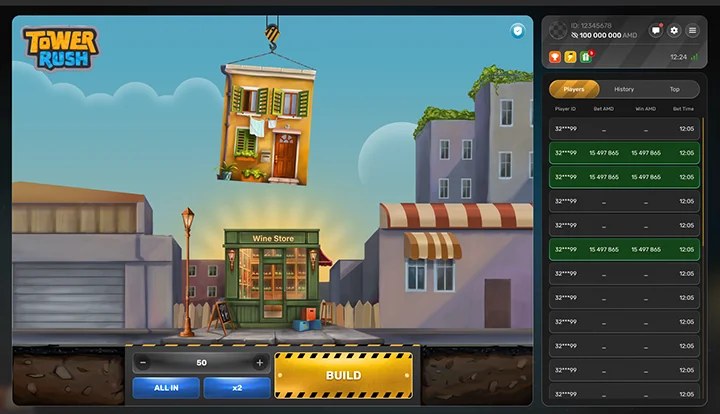
The loop only ever ends in one of two ways. Either the displayed value is collected and secured, or the tower collapses first and the unsecured value for that round is gone. There is no third outcome and no stored progress: a run that almost reached another floor counts for nothing on the next attempt.
How Tower Rush Multipliers and Odds Work
The single most important idea in Tower Rush is that floor factors multiply together; they do not add. The worked example below uses illustrative figures to show how the cumulative odds and the potential return are built from a starting stake of 100 credits. These numbers are for explanation only and do not represent any specific version.
| Stage | Illustrative floor factor | Cumulative calculation | Potential return |
|---|---|---|---|
| Starting stake | - | 1.00 | 100 credits |
| Floor 1 | 1.20 | 1.20 | 120 |
| Floor 2 | 1.25 | 1.20 x 1.25 = 1.50 | 150 |
| Floor 3 | 1.40 | 1.50 x 1.40 = 2.10 | 210 |
A collect at Floor 3 returns 210 credits on paper, and the gain above the 100-credit stake is 110 credits. Two points are worth holding onto. First, the return is not pure profit, because the stake itself is part of the figure shown. Second, rising cumulative odds do not remove risk: the moment before a collect, a collapse still ends the whole run with nothing from it, no matter how tall the tower has become.
Tower Rush RTP Explained
Galaxsys publishes a return-to-player (RTP) range of 96.2% to 97.6% for Tower Rush. The house edge is simply the part that is not returned over the long run, calculated as 100% minus the RTP. At the top of the range an RTP of 97.6% leaves a house edge of about 2.4%, and at the bottom an RTP of 96.2% leaves a house edge of about 3.8%.
A published range rather than a single number means the title can be configured with different RTP values across different versions and platforms. RTP is also a theoretical long-run average measured across a very large number of rounds, not a refund on a session: an RTP near 97% does not mean every 100 credits returns 97, and a single session can land far above or far below the average. The figure in the panel in use is the one that applies, so it should be confirmed there rather than taken from any number quoted elsewhere.
Tower Rush Bonus Floors
Galaxsys names three bonus-floor types. The table records only what is confirmed by name and points to the information panel for the exact mechanics, because those effects can change between versions.
| Bonus-floor type | What is officially confirmed | What must be checked in the game |
|---|---|---|
| Frozen | One of the three named bonus-floor types | Its exact effect and any value it may preserve |
| Temple | One of the three named bonus-floor types | The value or modifier it may add and how it resolves |
| Triple Build | One of the three named bonus-floor types | What the three-floor sequence actually adds to the odds |
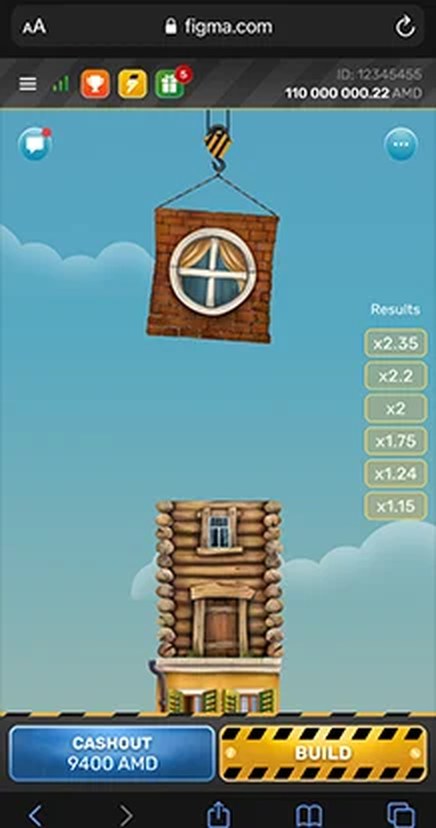
Bonus floors are part of the random system, so they are never due and cannot be forced. No stake size, tapping pattern or time of day makes one appear, and a bonus floor does not reveal the next result. When one lands, it lands because the game system produced it, not because of anything done at the controls.
How to Start with Tower Rush Demo Mode
Demo mode is the safest way to learn, because it runs on virtual credits with no cash value. These steps are worth working through the first few times, with the session kept short so the practice stays deliberate.
- 1Open a verifiable demo source. Start from the official Galaxsys page or a platform that clearly identifies Galaxsys, and confirm the source before the first round.
- 2Confirm the balance is virtual. The credits are confirmed as practice money with no withdrawable value. A genuine demo never asks for a deposit, a UPI PIN or card details.
- 3Open the information panel. The rules, the RTP and the stake range are read for the version in use before the first floor is built.
- 4Use a small virtual stake. The amount is kept low and fixed so the cumulative calculation stays easy to follow.
- 5Practise both decisions. Collecting early on some rounds and continuing on others shows how each choice plays out without money at stake.
- 6Review the round record. After each round, the history shows what happened rather than a pattern that does not exist.
For a fuller walkthrough of reaching and using the practice version, see our demo online guide, which covers the safety checks and controls in more detail.
Tower Rush in India
India's Promotion and Regulation of Online Gaming Act, 2025 addresses online money games directly. The government issued an enforcement notification on 22 April 2026, and the relevant provisions commenced on 1 May 2026, prohibiting online money games, their advertising and related fund transfers. For that reason this guide gives no deposit instructions and covers only the free demo.
An offshore licence, an INR balance or a UPI option does not override Indian law. The legislation is published on India Code. This is general information rather than legal advice, so the free demo is the place for practice and professional advice is the right route for an individual situation.
Tower Rush: Auto Cash-Out and Other Optional Controls
Some versions add optional controls on top of the basic Build and Collect buttons. They can help in sticking to a plan, but none of them changes the odds or predicts a result. The in-game explanation is worth reading before any of them is switched on.
Auto Cash-Out
Auto cash-out collects a round automatically once the cumulative odds reach a level set in advance. It removes some in-the-moment emotion and helps in holding to a stopping point, but it does not know what the next floor will be and it does not shift the house edge.
Dual Betting
Some versions allow two stakes to run at once, which allows one position to be collected early while the other continues. This changes how a session feels rather than the underlying probability, and it doubles the value being exposed, so it calls for more caution, not less.
Quick Double
A quick-double control raises the stake with a single tap, which some players use to run a Martingale style chase. Starting at ₹10 and doubling after each collapse produces ₹10, ₹20, ₹40, ₹80, ₹160 and ₹320, which is six stakes totalling ₹630, and the next single stake would already be ₹640. Doubling does not change the random result, and a short losing streak or a stake limit can end the chase with a heavy loss before it ever recovers.
Tower Rush: Does Timing the Crane Matter?
No. The crane that lowers each floor into place is an animation, and the result of the floor is decided by the random number generator, not by the moment of the tap. Fast taps, slow taps, tapping in a rhythm and tapping at a particular point on the screen all produce the same kind of random outcome.
This matters because a lot of misleading advice treats the crane as a skill element or a timing puzzle. It is neither. The only genuine choices are how much to stake and when to collect, and neither of those changes the odds of the next floor.
Tower Rush: How to Check Provable Fairness
Where a version offers provable fairness, a completed round can be checked to confirm that a result was not altered. The check typically uses a round identifier, a hashed value shown before the round, a seed and a nonce, which are entered into the provided verifier once the round is complete.
Follow the current fairness panel for the exact steps, because the method can differ between versions. Two cautions apply throughout. Verification confirms honesty after the fact; it is not prediction and it does not remove the house edge. A password or a one-time password (OTP) should never be entered into an external checker, because a genuine fairness tool needs only the round data, never account credentials.
Tower Rush: What Happens If the Connection Drops?
The state of a round lives on the game server, not on the screen, so a dropped connection usually does not cost an in-progress round. Once the connection returns, the server settles the round according to what actually happened, whether that was a collect or a collapse.
Two habits keep this simple. The Build control should not be pressed repeatedly while the screen is frozen, because unintended actions can be queued. And the round identifier is worth recording so the outcome can be found in the round history once the connection returns and confirmed as settled.
Tower Rush: Beginner Practice Tips
A short, structured approach makes the demo far more useful than random tapping. These habits build the only skill Tower Rush actually rewards, which is disciplined decision making.
- A single small virtual stake is kept while learning, so the cumulative calculation stays easy to read.
- A stopping point is decided before each round and held to, whatever the tower does.
- Collecting early on some rounds and continuing on others helps in feeling the trade-off.
- A session time limit is set and treated as a firm boundary, because fast rounds are easy to over-play.
- The round history is for reviewing what happened, not for searching a pattern.
- The information panel is read for every new version rather than the settings being assumed to carry over.
Tower Rush: Common Mistakes to Avoid
Most early errors come from misreading how the game works. Tower Rush breaks the action into separate floors rather than one continuous curve, and misunderstanding that difference is where beginners lose the plot. The mistakes below are the ones to guard against.
- Treating the crane animation as a timing test rather than decoration.
- Adding floor factors together instead of multiplying them.
- Reading a return figure as pure profit when the stake itself is part of it.
- Assuming a good run on virtual credits predicts real-money results.
- Believing a bonus floor is due because it has not appeared for a while.
- Increasing the stake after a collapse to chase back a loss.
- Installing a predictor tool or a modified APK that claims an edge.
- Ignoring the RTP that actually applies to the version in use.
Tower Rush: What Players Say About This Guide
The comments below are illustrative examples of the kind of feedback India-facing players commonly share about learning Tower Rush. They are not submitted or independently verified reviews from named individuals, and results vary from player to player.
★★★★★ · Priya, Chennai
“The step-by-step breakdown finally made the crane timing click for me. I practised in demo mode until Cash Out felt natural before trying anything else.”
★★★★☆ · Arjun, Mumbai
“Useful walkthrough of the multiplier maths. I wish I had read the auto cash-out section before my first few sessions.”
★★★★★ · Meera, Jaipur
“Clear explanation of the bonus floors without any hype. It helped me understand what the Frozen Floor actually does.”
★★★★☆ · Karan, Kolkata
“Good beginner mistakes section. I was making the classic error of chasing losses before reading this guide.”
How to Play Tower Rush FAQ
Is an application download needed to play Tower Rush?
No. The official Galaxsys demo runs in a mobile or desktop browser, so no separate application or any APK file needs to be installed. Avoid downloads that promise unlimited credits, a predictor or an unlocked version, because a genuine browser demo never requires them.
What virtual stake should a beginner use?
The smallest practice amount available is best while learning. The virtual stake only changes the numbers on screen; it does not improve the chance of a successful floor and it does not change the cumulative odds. A small stake keeps the calculation easy to follow, which leaves attention on the build-and-collect decision.
Does crane timing affect the result?
No. The crane and the building animation are decoration. Where or when the screen is tapped does not influence the outcome, because each floor is produced by a random number generator. The animation is feedback rather than a timing test that can be won.
Can Tower Rush be played in Hindi?
The interface language depends on the platform integration rather than the game itself. Some hosts provide a language selector and others do not, so whether Hindi text appears is decided by the platform the demo is opened on. The underlying mechanics and odds are the same whatever language is displayed.
What happens if the internet disconnects during a round?
The game server, not the screen, records the state of a round, so a dropped connection is usually settled by the server once the connection returns. The Build control should not be pressed repeatedly while the screen is frozen, and the round identifier is worth noting so the outcome can be confirmed in the round history when the connection returns.
Can the next collapse be predicted?
No. Results are random and independent, so no tool, signal group or pattern can tell when the next collapse will happen. Round history shows what already occurred; it cannot reveal a future result, and any product that claims to predict a collapse is misleading.
Tower Rush: Play as Entertainment, Not Income
Tower Rush is a fast game of chance, not employment, an investment or a guaranteed income source. Its published RTP stays below 100%, its results involve chance, and no system, signal or predictor can change that. The healthiest way to enjoy the building loop is to keep it in the free demo, where every control and all three bonus floors can be experienced without financial consequences.
If play ever stops feeling like fun, our responsible gambling guidance covers firm limits to set before the next session. This guide was last reviewed on 16 July 2026.
18+ only. Tower Rush is a game of chance. India: Tele-MANAS 14416 or 1800-89-14416; emergency 112. Never chase losses.
Tower Rush Game Screens
Real Tower Rush captures, so every visual below shows the actual Galaxsys product rather than a redrawn mock-up.