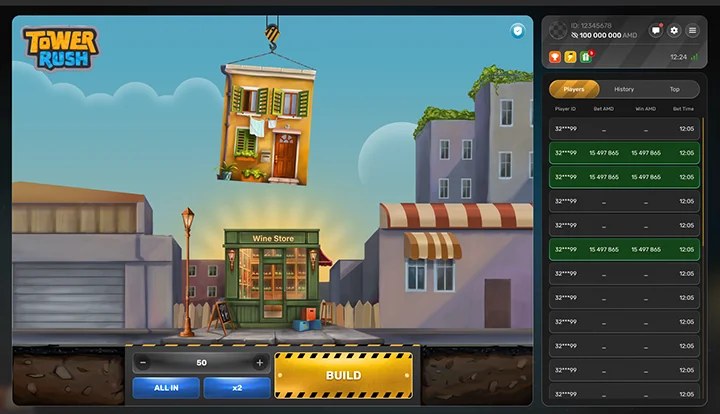
Our Tower Rush game strategy is built around clear decisions, disciplined limits and practical game understanding. Tower Rush is a fast Galaxsys game where every Build decision matters, every floor changes the risk level and every cash out choice shapes the session. We keep the strategy simple: understand the maths, choose the exit before the round starts, use trap settings with purpose and protect the bankroll from emotional decisions.
Contents
Why Strategy in Tower Rush Means Risk Control, Not Prediction
Our Tower Rush strategy starts with one honest principle: strategy is about control, not prediction. Tower Rush uses random game mechanics, so the next floor is not something a player can read from timing, taps, previous collapses or screen rhythm. What we can control is the size of each bet, the selected trap lane, the target multiplier, the stop point and the total amount placed into a session.
Tower Rush is published by Galaxsys, a recognised game studio within the Digitain group. The official Tower Rush information (Galaxsys product page) lists an RTP band of 96.2% to 97.6%. In plain language, RTP is the theoretical long-run return calculated across a large volume of play. The opposite side of that number is the house margin. A 96.2% RTP means a theoretical house margin of about 3.8%. A 97.6% RTP means a theoretical house margin of about 2.4%.
| RTP Display | Theoretical House Margin |
|---|---|
| 96.2% | 3.8% |
| 96.5% | 3.5% |
| 97.0% | 3.0% |
| 97.6% | 2.4% |
This is why our Tower Rush winning strategy focuses on session quality. A player who bets ₹500 each round with no stop rule exposes the bankroll much faster than a player who uses ₹50 or ₹100 per round with a fixed exit. Strategy cannot change the mathematical design of the next result, but it can change the cost of learning, the speed of losses during cold sequences and the discipline needed to lock in a completed multiplier.
For us, a strong Tower Rush strategy has four pillars: a small stake, a chosen cash out zone, a selected trap setting and a written stop rule. This keeps the game structured from the first round.
Tower Rush: The Maths Behind Every Build Decision
Tower Rush looks simple because every decision is built around one core action: Build or cash out. Under the surface, the value changes floor by floor because multipliers compound. They do not add in a straight line.
Multipliers Compound, They Do Not Add
If a player starts with ₹100 and the multiplier moves through several successful floors, the value does not grow like ₹100 plus one fixed amount each time. It grows by multiplying the current value. That is what makes Tower Rush exciting and what also makes later floors more sensitive.
| Floor Stage | Example Multiplier | Value from ₹100 |
|---|---|---|
| Start | 1.00x | ₹100 |
| Floor 1 | 1.40x | ₹140 |
| Floor 2 | 1.80x | ₹180 |
| Floor 3 | 2.40x | ₹240 |
| Floor 4 | 3.20x | ₹320 |
These figures are educational examples, not official probability values. The key lesson is that every extra floor places the full current value into the next Build decision. The full displayed value stands at risk once a sequence reaches ₹280, not only the original ₹100.
Why Each Extra Floor Risks the Whole Sequence
If a run grows from ₹100 to ₹280, the next Build decision puts the ₹280 outcome at stake. That is why Tower Rush requires a planned exit before the excitement rises. The emotional mistake is treating the higher displayed value as "house money". In the session, it is still the current value on the screen once Cash Out becomes available.
Our practical rule is simple: once a run reaches the target zone, we secure it. If the target was 2x, we do not change it to 5x during the round. If the target was 5x, we do not push it to 10x because the previous floors felt smooth. Tower Rush is designed to move quickly, so a rule decided before the round is stronger than a decision made during the rush.
Cumulative Probability Falls Fast
Every extra floor reduces the chance of completing the full sequence. To explain this clearly, we use a simple educational model where each floor has a hypothetical 2-out-of-3 success chance, equal to 66.67%. This is an educational illustration, separate from the published Tower Rush probability model. It only shows how repeated success becomes less likely as the number of required floors increases.
| Consecutive Floors Needed | Educational Probability Model |
|---|---|
| 1 floor | 66.67% |
| 2 floors | 44.44% |
| 3 floors | 29.63% |
| 4 floors | 19.75% |
| 5 floors | 13.17% |
This is the core of how to win Tower Rush game from a discipline point of view: avoid asking every round to do too much. Small exits happen more often than tall runs. Big multipliers can appear, but a session built only around tall runs carries sharper swings.
Tower Rush Cash Out Strategy: Setting the Exit Before the Build
Our Tower Rush cash out strategy begins before the round starts. We choose the exit first, then we play the round around that exit. This protects the session from last-second decisions.
The Early Exit Zone
The early exit zone usually sits around 1.5x to 2x. This approach suits players who prefer shorter exposure and more frequent completed rounds. It does not remove risk, but it keeps the target closer and reduces the number of floors a run must survive.
A beginner who starts with ₹100 per round and targets 1.5x is aiming to cash out around ₹150. At 1.75x, the target is ₹175. At 2x, the target is ₹200. The benefit is simplicity. The trade-off is that early exits do not capture the full value of rare taller runs.
We recommend this zone for players learning the game, testing trap settings or practising session discipline. It gives enough movement to understand the game without pushing every round into high volatility.
The Target Multiplier Method
The target multiplier method uses a fixed number such as 5x or 10x. This approach suits players who accept sharper variance in exchange for a larger target. The value of this method comes entirely from consistency. If the target is 5x, the round ends at 5x. If the target is 10x, the round ends at 10x.
Changing the target during a live run weakens the method. A player who starts with a 5x goal and then pushes to 12x is no longer using a fixed target. That player is making a fresh emotional decision inside the round.
For structured sessions, we prefer a written target before the first attempt. Example: "₹50 stake, 5x target, maximum 20 attempts, stop after ₹500 loss or ₹750 profit." That single line gives the session a clear boundary.
Tower Rush Auto Cash Out Setting
The Tower Rush auto cash out setting is useful because it removes emotion from the exit. A player can set the target before the round and allow the system to cash out once the chosen multiplier is reached. For beginners, our practical band is 1.5x to 1.75x because it keeps the goal close and makes the learning phase easier to measure.
Auto cash out is not a prediction tool. It is a discipline tool. It helps players avoid the common mistake of watching the multiplier rise and moving the goal repeatedly. When used correctly, it turns the chosen strategy into an automatic action.
The One Rule That Matters
Decide the exit before pressing Build. Never decide it during the run.
That one rule carries the entire strategy. Tower Rush moves fast, and fast games reward preparation. Whether the target is 1.5x, 2x, 5x or 10x, the strength of the method comes from respecting the line once the round begins.
Tower Rush Trap Settings: 1, 2 and 3 Explained
The Tower Rush trap settings shape the volatility lane. They do not create an advantage over the house edge, and they do not predict the next floor. Their job is to change the feel of the risk path.
1 Trap
The 1 Trap setting is the lower-volatility lane. It generally feels more controlled because smaller progressions can appear more frequently. This setting suits beginners, early exit players and anyone practising bankroll discipline in demo mode.
A player using 1 Trap may choose a 1.5x to 2x cash out range and a small stake. The session can still turn unfavourable, but the lower-volatility style makes it easier to observe the rhythm and practise consistent exits.
2 Traps
The 2 Traps setting sits in the middle. It gives sharper variance than 1 Trap while keeping the session less extreme than 3 Traps. This lane suits players who understand the cash out button, have already tested demo mode and want a balanced risk profile.
For 2 Traps, we prefer fixed targets. A player may choose 2x, 3x or a defined floor target, then stop after a specific number of attempts.
3 Traps
The 3 Traps setting is the high-volatility lane. It can produce repeated early failures and occasional taller runs. This lane is best handled with the shortest sessions, the smallest stake size and a hard stop rule.
A 3 Traps session without limits can move quickly. That is why we treat it as a special session type, not the default beginner setting.
| Trap Setting | Session Feel | Suits | Stop Rule |
|---|---|---|---|
| 1 Trap | Lower volatility | Beginners, early exits | Stop after set attempts or small loss limit |
| 2 Traps | Balanced variance | Fixed target players | Stop after target cycle ends |
| 3 Traps | High volatility | Advanced demo-tested sessions | Shortest session, strict hard limit |
Players can confirm exact rules, payout data and probability details in the live game panel when available.
Our Four Tower Rush Playing Styles
We organise Tower Rush strategy into four playing styles. Each style has a different purpose, but all four use the same foundation: small stakes, fixed exits and clear limits.
Conservative Builder
The Conservative Builder uses 1% to 2% of bankroll per bet and targets early exits. If the bankroll is ₹5,000, one bet stays between ₹50 and ₹100. If the bankroll is ₹10,000, one bet stays between ₹100 and ₹200.
This style suits players who want longer sessions and lower pressure. The goal is not to chase tall towers. The goal is to practise controlled cash outs and protect session time.
Fixed Target Player
The Fixed Target Player chooses a multiplier before the session begins. Examples include 2x, 3x, 5x or 10x. Once the target is reached, the round is closed. The target does not move during the round.
This style creates a clean structure. It is useful for players who want a measurable plan. After 20 attempts, a review shows how many targets were reached and whether the chosen multiplier felt suitable.
Bonus Floor Observer
The Bonus Floor Observer uses small stakes and watches how Frozen Floor, Temple Floor and Triple Build appear inside the game. Bonus floors are random and cannot be forced. This style is useful for learning the feature behaviour without turning every bonus appearance into a high-pressure decision.
Our rule is to keep the same cash out plan even when a bonus feature appears. A bonus floor can change the feel of the round, but the stop rule remains the anchor.
High Volatility Sessions
High Volatility Sessions use 3 Traps or taller targets. These sessions are short by design. We use a separate hard limit, a lower stake size and demo practice before real play.
This style suits players who understand that high volatility means sharper swings. The goal is not to play longer. The goal is to define the session tightly and stop when the limit arrives.
| Style | Risk Lane | Cash Out Zone | Stake Size | Stop Rule |
|---|---|---|---|---|
| Conservative Builder | Low | 1.5x to 2x | 1% to 2% bankroll | Time and loss limit |
| Fixed Target Player | Low to medium | 2x to 10x | Fixed stake | Target cycle limit |
| Bonus Floor Observer | Low | Pre-selected | Small stake | Feature study limit |
| High Volatility Session | High | Taller targets | Smallest stake | Short hard stop |
Tower Rush Bankroll Management Rules We Never Break
Our Tower Rush bankroll management framework keeps every session measurable. The first rule is stake size. We keep one bet at 1% to 2% of the session bankroll. With ₹2,000, that means ₹20 to ₹40 per round. With ₹5,000, that means ₹50 to ₹100. With ₹10,000, that means ₹100 to ₹200.
The second rule is setting both a win limit and a loss limit before play. A player may decide to stop after ₹500 profit or ₹300 loss. Both numbers matter. A win limit protects profit from being rolled forward endlessly. A loss limit protects the session from chasing.
The third rule is a timer. Tower Rush rounds can run quickly, often within a short 5 to 30 second window depending on gameplay flow. A 15 to 20 minute session is enough for structured play. Attempt caps also help. A player may choose 20, 30 or 40 attempts and stop when the cap is reached.
The fourth rule is profit separation. If a session produces a clean profit, we prefer withdrawing or moving the profit away from the next session balance. This keeps the next session from becoming larger only because the previous one went well.
The fifth rule is personal funding discipline. We play only with money set aside for entertainment. Borrowed money, bill money and emergency funds do not belong in a Tower Rush session.
Why Martingale Fails in Tower Rush
The Tower Rush martingale strategy risk is simple: doubling grows too fast. A Martingale-style plan increases the stake after each loss, usually with the hope that one win recovers the sequence. In Tower Rush, this can breach a bankroll limit very quickly.
| Attempt | Doubled Stake |
|---|---|
| 1 | ₹20 |
| 2 | ₹40 |
| 3 | ₹80 |
| 4 | ₹160 |
| 5 | ₹320 |
| 6 | ₹640 |
| 7 | ₹1,280 |
| 8 | ₹2,560 |
| 9 | ₹5,120 |
| 10 | ₹10,240 |
A ₹20 starting bet can become ₹10,240 by the tenth attempt. That is 512 times the first stake. Most bankrolls, table limits and personal loss limits cannot support that growth.
Tower Rush rounds are independent. A previous collapse does not make the next successful Build more likely. This is why we treat doubling progressions as a bankroll pressure system, not a strategy. Our approach keeps stake size stable and stops the session before the numbers become uncomfortable.
Tower Rush: Strategies and Claims We Reject
We keep Tower Rush strategy clean, practical and game-based. Predictor bots, signal groups, timing hacks, guaranteed-win systems and tapping patterns do not belong in our strategy framework. Tower Rush results are handled through random game mechanics and fairness systems, so a signal seller cannot turn future rounds into certain outcomes.
Our strategy tools are different: cash out targets, trap setting selection, bankroll rules, demo practice and session limits. These are real choices a player can control. Anything promising guaranteed results is outside our method.
Players who want the full fairness explanation can use our Tower Rush Predictor guidance, where we explain why completed rounds can be verified and future rounds cannot be forecast.
Practising Tower Rush Strategy in Demo Mode First
Demo mode is our preferred starting point for every new Tower Rush player. It gives the same game interface, the same decision flow and the same fast round rhythm with virtual credits. A player can practise without placing real money into the session.
Our 30-attempt demo plan is simple. Use the first 10 attempts to learn the controls. Watch the Build button, cash out display, multiplier movement and floor changes. Use the next 10 attempts to compare trap settings. Try 1 Trap, 2 Traps and 3 Traps with the same virtual stake size. Use the final 10 attempts to practise one stop rule. Set a target, follow it and stop after the chosen attempt count.
This creates a learning session with structure. The aim is not to win demo credits, but to learn decision timing, exit discipline and volatility feel.
Play Tower Rush with Clear Limits
Tower Rush is designed for fast, exciting sessions, and our strategy keeps that experience structured. We recommend demo practice first, small stakes, pre-set exits and clear session limits. Tower Rush is for adults only. If play ever feels stressful, pause the session and use support resources. In India, KIRAN can be reached at 1800-599-0019 for mental health support.
Tower Rush Strategy: Frequently Asked Questions
What is the best strategy for Tower Rush game in India?
The best Tower Rush strategy is disciplined risk control using small stakes, fixed cash out targets, selected trap settings and session limits.
Is there a guaranteed Tower Rush winning strategy?
No guaranteed Tower Rush strategy exists. Strategy helps with stake size, cash out timing, trap choice and session discipline.
What auto cash out setting should beginners use?
Beginners can practise with a 1.5x to 1.75x auto cash out band in demo mode before choosing a real-money setting.
Do trap settings change the Tower Rush RTP?
Trap settings change the volatility lane, not the core house edge. The published RTP range remains part of the game design.
Does the Martingale strategy work in Tower Rush?
We do not use Martingale in Tower Rush because doubling stakes can breach bankroll limits very quickly.
Can bonus floors be triggered with a strategy?
Bonus floors such as Frozen Floor, Temple Floor and Triple Build are random features and cannot be forced by timing or stake size.
How much of a bankroll should one Tower Rush bet be?
We keep one Tower Rush bet around 1% to 2% of the session bankroll.
Does demo mode strategy carry over to real money play?
Demo mode helps players learn controls, volatility and cash out discipline. Real-money play needs the same structure with strict limits.
18+ only. Tower Rush is entertainment, not income. Set limits, take breaks, never chase losses. India helpline KIRAN (24x7): 1800-599-0019.
Reviewed by the Tower Rush Play Editorial Team. Independent iGaming analysts covering crash and turbo games for India. We published these notes on 19 August 2026 and last updated them on 19 August 2026.
Tower Rush Game Screens
Real Tower Rush captures, so every visual below shows the actual Galaxsys product rather than a redrawn mock-up.